
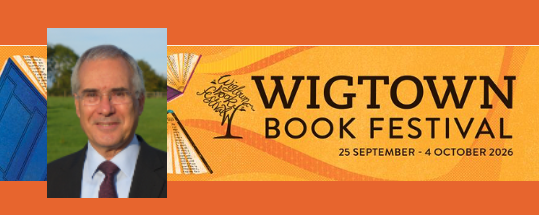
Two decades after his landmark review for the UK government, Professor Nicholas Stern will use his appearance at Wigtown Book Festival to argue that the world can build a new era of growth and development.
But immediate action is essential to avoid catastrophic climate change.
The professor offers a vision which is far more attractive than the dirty, destructive model of the past.
One of the world’s leading economic thinkers, Stern will deliver this year’s James Mirrlees Lecture, which commemorates the Nobel Prize winning economist who was raised in the Galloway village of Minnigaff.
His message is urgent, and it cuts two ways. Act decisively now and the prize is a cleaner, safer, and much better path of growth and development. Delay, and the damage becomes locked in, and, for many, could be existential.
The professor’s latest book, The Growth Story of the 21st Century: The Economics and Opportunity of Climate Action(LSE Press, Open Access), builds on the 2006 Stern Review, which argued that the costs of inaction are far greater than the costs of action and that climate change is the greatest market failure ever seen.
Where the review set out the costs of inaction, the new book explains why investing in the new can deliver a different kind of growth, providing sustainable and resilient development across the world, is within reach. And how to get there.
He said: “The next decade will determine whether we avoid climate, biodiversity, and economic catastrophe – or unlock a new era of sustainable, resilient, and inclusive growth.”
“The idea that we must choose between climate action and development is outdated and must be challenged. A transformation is possible that delivers both prosperity and a healthier planet.”
He added: “I am very optimistic about what we can do. I worry about what we will do. The challenge of leadership, of politics and of social action is to turn what we can do into what we will do.”
Investing strongly now, he argues, can break the damaging relationship between economic activity and the environment that is built into the technologies and methods we currently use to produce and consume.
While Stern is clear that failure will bring disaster, the book is optimistic, examining how rapid technological advances, including digitisation and AI, can drive change at the necessary scale.
He argues that clean technologies are already cheaper than dirty ones across an expanding range of sectors, and that the business prospects they offer are enormously appealing.
He said: “Firms are recognising the investment opportunities in creating the growth story of the future.”
“They are investing and innovating at pace and scale, understanding that the technologies of the 21st century will be more profitable, less risky, and less destructive than those of the 19th and 20th centuries.”
Five forces, he believes, are already driving positive change, or could be harnessed to do so:
- Rapid technological change and falling costs.
- International agreements that have provided political direction and show collaboration is possible.
- Growing private sector commitments to the investment and growth opportunities.
- The use of global savings to drive investment in more sustainable growth.
- Strong movements of young people around the world
Stern, Chair of the Global School of Sustainability and the Grantham Research Institute, at the London School of Economics and Political Science (LSE), said: “The prize is a safer planet and a new and much better path of growth and development.”
Stern’s book has been praised by leading figures from across the world ranging from former Lib Dem leader Sir Vincent Cable (who is also speaking at Wigtown) and Tory ex-Chancellor Jeremy Hunt, to Lord Gus O’Donnell, Former UK Cabinet Secretary, and former US Vice President Al Gore, Lord John Browne, former CEO of BP, Sir Paul Nurse, President of the Royal Society.
He will also use the lecture to pay tribute to James Mirrlees, who took him on as a graduate student in 1967 and was a guide, mentor, and friend in the decades that followed.
Change the Stories
Climate change can feel too big to contemplate, much less affect. Wigtown Book Festival’s programme includes the Change the Stories strand, which offers fresh ways to look at the ongoing crisis, and ideas about how to make a difference.
- Stephen Rutt: The Waterlands. Journey from the Lowther Hills to the Firth of Clyde and beyond with an award-winning naturalist who’ll explain the threat to our water supplies and reveal why there’s still hope for our wetlands.
- Gabriella Bennett: Journeys Into the Urban Future. As climate change and innovation transform our lives, how to ensure the places we live serve our needs.
- Arthur Snell: The New Geography of Climate Change. The climate crisis is real. Can we survive and adapt? Meet the former diplomat to hear about the dangers and opportunities.
- David Shukman: Britain’s New World of Extremes. Flash floods, wildfires, heatwaves – we have never been more at risk from a hostile climate. The former BBC Science Editor argues that change is possible.
- Ben Rawlence: Letters to My Children from a Changing Planet. How do we raise children during a climate emergency? Bold ideas for saving ourselves and those we love.
- Christina Riley: Looking Down at the Stars. Meet the underwater artist in residence who has been recording marine life along Scotland’s west coast.
- Cal Flyn: The Savage Landscape. Travel to the remotest places on Earth with an award-winning Scottish nature writer as she contemplates why we seek out wild spaces and how we might preserve them.
- John Kampfner: Braver New World. Housing, health, education and energy – when it comes to society’s biggest challenges, we seem to be failing. One of Britain’s most respected journalists has travelled the globe to find answers.
Wigtown Book Festival takes place in Scotland’s National Book Town from 25 September to 4 October, and the Mirrlees Lecture is on 26 September.
-Ends-
Notes
- For more about Wigtown Book Festival see www.wigtownbookfestival.com
About Nicholas Stern
Nicholas Stern is IG Patel Professor of Economics and Government, Chair of the Grantham Research Institute on Climate Change and the Environment, and Chair of the Global School of Sustainability at the London School of Economics and Political Science (LSE). He has held posts at other UK and overseas universities and as Chief Economist at both the European Bank for
Reconstruction and Development (EBRD) and the World Bank. He was at the UK Treasury, 2003–2007, where he was Second Permanent Secretary and Head of the UK Government Economic Service, led the writing of the report of the Commission for Africa (2005), and produced the Stern Review on the economics of climate change in 2006. He has served as President of the European Economic Association (2009), of the Royal Economic Society (2018–2019), and of the British Academy (2013–2017). He was elected Fellow of the Royal Society (June 2014). He was knighted for services to economics (2004), made a life peer (2007), and appointed Companion of Honour for services to economics, international relations, and tackling climate change in 2017. He has published more than 25 books and over 200 articles.
About VisitScotland
VisitScotland is Scotland’s national tourism and events organisation. Its core purpose is to drive the visitor economy, growing its value in Scotland. As an economic growth agency, VisitScotland’s activity focuses on three key priorities – market development, place development and business and experience development. VisitScotland’s work helps deliver the ambitions of the national tourism strategy, Scotland Outlook 2030, for Scotland to be a world leader in 21st century tourism, and Scotland’s National Events Strategy 2024 – 2035.
It leverages tourism and events as a force for good for all of Scotland’s people and places and builds Scotland’s international profile as a leading place to visit, live, work, study and do business. For VisitScotland’s press releases, tourism statistics and frequently asked questions go to visitscotland.org or follow us on @VisitScotland on LinkedIn.
About Creative Scotland
Creative Scotland is the public body that supports culture and creativity across all parts of Scotland, distributing funding provided by the Scottish Government and The National Lottery. Further information at creativescotland.com. Follow Creative Scotland on Facebook, LinkedIn, and Instagram.
For media information: Matthew Shelley at Matthew@ScottishfestivalsPR.org or 07786 704299.
Wigtown Festival Company, 26 South Main Street, Wigtown, Dumfries & Galloway, Scotland, UK, DG8 9EH. Wigtown Festival Company is a company limited by guarantee with charitable status. Scottish Charity No. SC037984
