
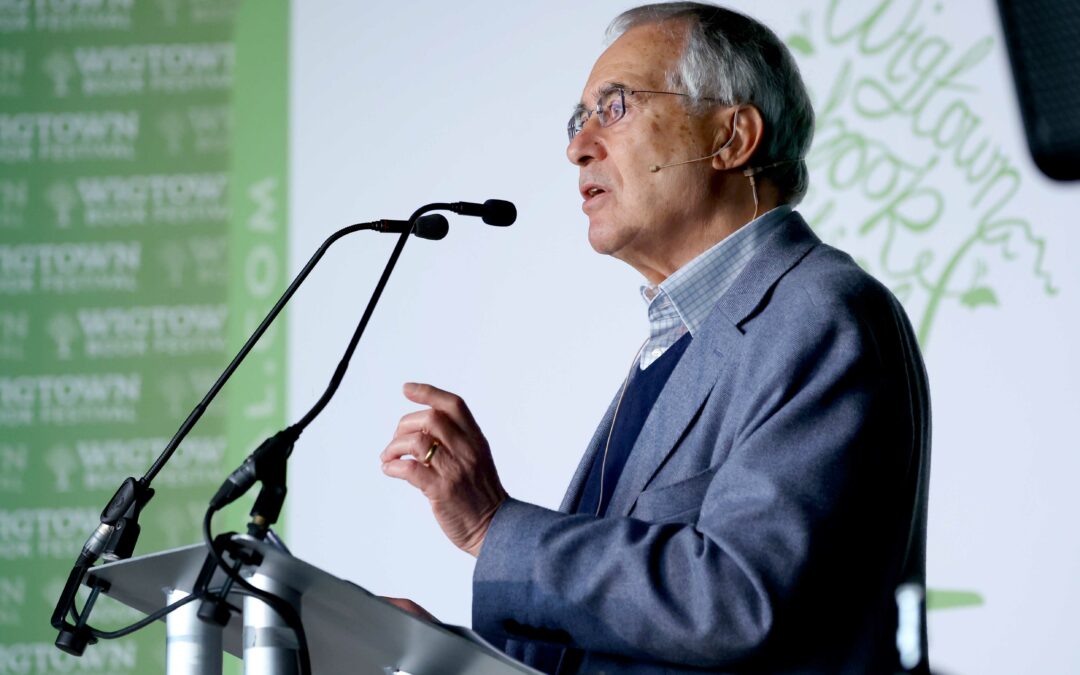
Climate change is getting worse, but advances in technology and AI can offer a brighter cleaner future, if we act decisively and fast – according to world-leading economist Nicholas Stern.
Delivering the fifth annual James Mirrlees Lecture at Wigtown Book Festival, the professor was deeply critical of attempts to write off Net Zero policies as “ideological”.
He said: “Net Zero is a very simple piece of physics. And the earlier you get to Net Zero, the lower the temperature at which you stabilise. Sometimes people use the word ‘ideological’ around the subject of Net Zero. It’s the opposite of ideological. It’s basic physics.”
Twenty years on from the landmark Stern Review his new book The Growth Story of the 21st Century: The Economics and Opportunity of Climate Action (LSE Press, Open Access) expresses optimism for what we can do while spelling out the consequences of inaction.
One of the deepest concerns is that global temperatures are rising faster than predicted in 2006 and the science is showing that the results of any given increase will be even worse. The recent glacier collapse in Tibet and Nepal offers a small foretaste of what could lie ahead.
He said: “Every time you look at the science, it looks worse. Every time you look at the technology, it looks better.”
Prof. Stern added: “We are in the era of the end of the internal combustion engine, we’d never have predicted that 20 years ago.”
Positives emphasised by Prof. Stern included:
- Rapid technological change and falling costs – such as plummeting solar power prices.
- International agreements providing political direction and showing that collaboration is possible.
- Growing private sector commitments to the investment and growth opportunities.
- The use of global savings to drive investment in more sustainable growth.
- Strong movements of young people around the world.
He added: “There’s one piece of luck. AI has come at the right time from the point of view of managing systems.
“Cities are complicated systems. AI can be very helpful in designing, redesigning and running those systems. Moving electricity around across space and geography, according to supply and demand and availability, smart grids. That’s a very big part of the story.”
Stern argues that the next two decades are decisive and that the cost of action is lower than of inaction – with clean technologies already the cheapest option in many sectors.
Investment is needed, along with political action, to ensure that cleaner, better technologies thrive and dirtier, damaging ones are phased out.
Act now and the prize is a cleaner, safer, and much better path of growth and development. Delay, and the damage becomes locked in, and, for many, could be existential.
Right now we are accelerating towards a series of tipping points such as:
- The collapse of the Amazon forest system
- The thawing of the permafrost, and the releasing of a lot of methane
- Melting of the polar ice caps.
The last of these has especially dramatic effects.
Prof. Stern said: “Remember, if the land based ice slides into the water, sea levels go up very quickly. It’s the Archimedes principle.
“Of course, as you lose the ice, you lose the reflection too, and that is part of the process of tipping points.
“If we start to see those tipping points kicking in, then it could become almost unmanageable because they feed off each other.”
Stern, who is Chair of the Global School of Sustainability and the Grantham Research Institute, at the London School of Economics and Political Science (LSE), said he is not a campaigner, simply “a professor who studies and tries to write about and explain ideas”.
He says he is enormously optimistic about what we can do to combat climate change and build a clean, prosperous future – but is fearful that we won’t.
Stern’s book has been praised by leading figures from across the world ranging from former Lib Dem leader Sir Vincent Cable (who is also speaking at Wigtown) and Tory ex-Chancellor Jeremy Hunt, to Lord Gus O’Donnell, Former UK Cabinet Secretary, and former US Vice President Al Gore, Lord John Browne, former CEO of BP, Sir Paul Nurse, President of the Royal Society.
Prof. Stern also used the lecture to pay tribute to Galloway-born Nobel Prize winner James Mirrlees, who took him on as a graduate student in 1967 and was a guide, mentor, and friend in the decades that followed.
-Ends-
Notes
- For more about Wigtown Book Festival see www.wigtownbookfestival.com
About Nicholas Stern
Nicholas Stern is IG Patel Professor of Economics and Government, Chair of the Grantham Research Institute on Climate Change and the Environment, and Chair of the Global School of Sustainability at the London School of Economics and Political Science (LSE). He has held posts at other UK and overseas universities and as Chief Economist at both the European Bank for
Reconstruction and Development (EBRD) and the World Bank. He was at the UK Treasury, 2003–2007, where he was Second Permanent Secretary and Head of the UK Government Economic Service, led the writing of the report of the Commission for Africa (2005), and produced the Stern Review on the economics of climate change in 2006. He has served as President of the European Economic Association (2009), of the Royal Economic Society (2018–2019), and of the British Academy (2013–2017). He was elected Fellow of the Royal Society (June 2014). He was knighted for services to economics (2004), made a life peer (2007), and appointed Companion of Honour for services to economics, international relations, and tackling climate change in 2017. He has published more than 25 books and over 200 articles.
About VisitScotland
VisitScotland is Scotland’s national tourism and events organisation. Its core purpose is to drive the visitor economy, growing its value in Scotland. As an economic growth agency, VisitScotland’s activity focuses on three key priorities – market development, place development and business and experience development. VisitScotland’s work helps deliver the ambitions of the national tourism strategy, Scotland Outlook 2030, for Scotland to be a world leader in 21st century tourism, and Scotland’s National Events Strategy 2024 – 2035.
It leverages tourism and events as a force for good for all of Scotland’s people and places and builds Scotland’s international profile as a leading place to visit, live, work, study and do business. For VisitScotland’s press releases, tourism statistics and frequently asked questions go to visitscotland.org or follow us on @VisitScotland on LinkedIn.
About Creative Scotland
Creative Scotland is the public body that supports culture and creativity across all parts of Scotland, distributing funding provided by the Scottish Government and The National Lottery. Further information at creativescotland.com. Follow Creative Scotland on Facebook, LinkedIn, and Instagram.
For media information: Matthew Shelley at Matthew@ScottishfestivalsPR.org or 07786 704299.
Wigtown Festival Company, 26 South Main Street, Wigtown, Dumfries & Galloway, Scotland, UK, DG8 9EH. Wigtown Festival Company is a company limited by guarantee with charitable status. Scottish Charity No. SC037984
