
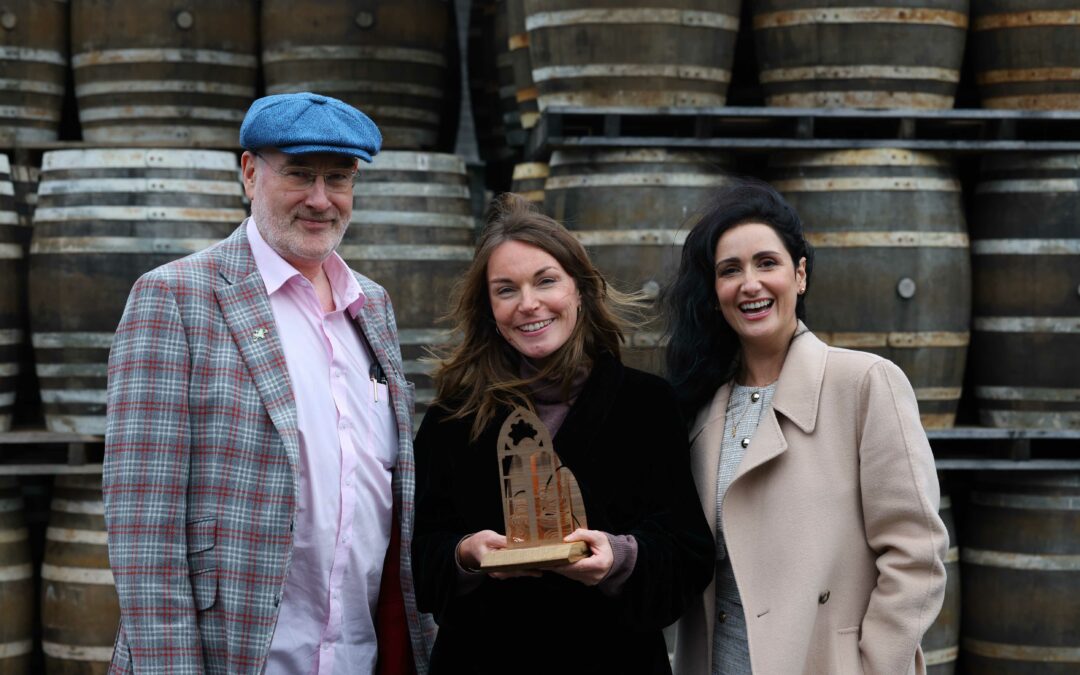
The fifth annual Anne Brown Essay Prize has been awarded to Jemma Neville for Crunch – described as a gracefully written work of tenderness, intelligence and ambition.
Her essay was selected from a strong field of 10 finalists, with Stephen Stewart’s Bield and Esa Aldegheri’s When Did the War Begin? being highly commended.
Crunch is a compelling combination of the personal and political, focussing on a young apple tree as a symbol of care, continuity and hope.
Jemma said: “I am thrilled to win this award! Thank you very much to Wigtown Book Festival, the competition judges and the family of Anne Brown.
“This year’s shortlist is full of peers I admire and whose diversity of work demonstrates the many ways in which an essay can take shape. It’s particularly heartening that dispatches from the home front – a kind of telling the bees – can be valued in critical debate.”
Jemma has twice previously been highly commended in the awards and her journalism has been published in The Times, The Guardian, The Observer and elsewhere.
Journalist, presenter and writer Zara Janjua, one of the judges, said: “Crunch begins with the simple act of planting an apple tree and quietly grows into something much bigger – an exploration of motherhood, memory, nature, conflict and what it means to nurture hope in a world that can feel increasingly frightening.
“There is so much tenderness in the writing, but also real intelligence and ambition. Like the tree at its centre, the essay keeps putting out new branches, while remaining beautifully rooted in something intimate and human.”
Essayist, poet and critic Gerry Cambridge, who also judged the prize, added: “Judging this essay prize has been a challenge, an honour, a pleasure.
“Wigtown is one of the most adventurous, to my mind, of book festivals, and its essay prize provides a valuable forum of encouragement for this rarely foregrounded art.
“It has also been fascinating seeing what has preoccupied this year’s essayists: trauma was a big theme in 2026 – personal; societal; the paroxysms and divisions of our current moment.
“We finally settled on Jemma Neville’s piece which, via the symbol of a sapling apple tree bought at a local supermarket, riffed in various engaging ways – threading fact to fact like pearls on a necklace – on a frail hope for the future.
“Gracefully written, it lifted clear as a bird out of our undoubtedly harrowing present and attempted to take, via astonishing elements of the natural world, a view both human and ecological.”
The £1,500 prize and trophy were presented during a special event on Sunday, 4 October at Bladnoch Distillery on the final day of the 2026 Wigtown Book Festival.
Highly Commended essays
- Bield, Stephen Stewart.A former soldier who witnessed atrocities in Afghanistan explores the impact of post-traumatic stress disorder on his life, both emotional and physical.
- When Did the War Begin? Esa Aldegheri. While making pancakes for her children in Scotland, the author reflects on the bombing of Lebanon’s Litani River and connects it with memories of her Italian grandfather whose life was shaped by two world wars.
Gerry said: “The two highly commended essays both dealt with trauma in different ways, one via contemporary conflict in the Middle East against a backdrop of seemingly unending war, and the other via a more harrowingly personal and confronting lens.”
Zara said: “Bield is raw, vivid and incredibly candid, turning our assumptions about trauma on their head. There is something very powerful in the idea that the experiences which might have broken someone can also become their ‘bield’ – their shelter, ballast and means of survival.
“It is deeply personal writing that manages to speak to something much more universal about grief and resilience.”
“When Did the War Begin? had a poetic rhythm and style that completely swept me along.
“It takes an enormous, complex global and political question and gives us a deeply personal way into it, moving beautifully between a kitchen in Scotland, family memory and the lived reality of war. It reminded me of the writing I love in Elif Shafak – lyrical and intimate, but always reaching towards something much bigger.”
Commemorating Anne Brown
The prize commemorates Anne Brown (1942-2021), former chair of Wigtown Festival Company, who was also a BBC radio journalist and senior producer.
-Ends-
Notes
- The Anne Brown Essay Prize is organised by Wigtown Festival Company in association with The Herald.
- The prize is made possible thanks to the generous support of Anne Brown’s daughter Jo Lawrence and her son Richard Brown.
- It celebrates the best recent literary essay by a writer in, from or with a long-standing connection to Scotland.
- It rewards precise writing, original thinking, curiosity and creative approaches to non-fiction.
- Entries can be on any subject and the maximum length is 4,000 words.
Now in its fifth year, previous winners are Sarah Whiteside, Rodge Glass, Dani Garavelli, and Tamara Fulcher. The winning essay will be published on the Wigtown Book Festival website and also on The Herald newspaper website, with an excerpt appearing in the print edition.
For more about Wigtown Book Festival see www.wigtownbookfestival.com
About Jemma Neville
Jemma’s writing is always personal and political. She is mostly a writer of narrative non-fiction, with time and memory recurring themes. Her comment and features journalism has been published in The Times, The Guardian, The Observer and more on themes such as the environment, time-capsules and maternal healthcare.
Her debut book Constitution Street, finding hope in an age of anxiety (404Ink, 2019) tells the true stories of neighbours on one diverse street, framed within The Universal Declaration of Human Rights. Her works in progress explore how earliest memories are stored in the body, how photography disrupts autiobiographical memory, and about end of life review experiences.
Jemma has also contributed chapters to several published anthologies and has twice been Highly Commended in The Anne Brown Essay Prize (Away with the Birds, 2021; From Our Own Correspondent, 2024). She was guest writer in residence by invitation at Maison Marcelle in France in 2026, supported by Creative Scotland.
About Anne Brown
Anne had an accomplished career and spent most of her working life as a broadcast journalist with the BBC, starting in the London newsroom, moving to current affairs in Newcastle and in the mid-80s she joined BBC Radio Scotland, working as a reporter, presenter and producer in Dumfries, Selkirk, Aberdeen, Orkney and Shetland, as well as Edinburgh and Glasgow.
She wrote and produced many documentaries, produced Newsweek Scotland and Good Morning Scotland, and presented a regular series of programmes for the World Service. She was commissioned by Canongate to write a book about the alleged child abuse scandals in Orkney in 1991.
About EventScotland
EventScotland is working to make Scotland the perfect stage for events by securing and supporting an exciting portfolio of sporting and cultural events. It provides funding opportunities and access to resources and information to develop the industry.
EventScotland is a team within VisitScotland’s Events Directorate, the national tourism organisation, alongside Business Events and Development teams. For further information about EventScotland, its funding programmes and latest event news visit www.eventscotland.org or follow Twitter @EventScotNews and follow us on LinkedIn.
About Creative Scotland
About Creative Scotland: Creative Scotland is the public body that supports culture and creativity across all parts of Scotland, distributing funding provided by the Scottish Government and The National Lottery. Further information at creativescotland.com. Follow Creative Scotland on Facebook, LinkedIn, and Instagram.
For media information: Matthew Shelley at Matthew@ScottishfestivalsPR.org or 07786 704299.
Wigtown Festival Company Ltd, 26 South Main Street, Wigtown, Dumfries & Galloway, Scotland, UK. Wigtown Festival Company Ltd is a company limited by guarantee with charitable status. Scottish Charity No. SCO3798.
