
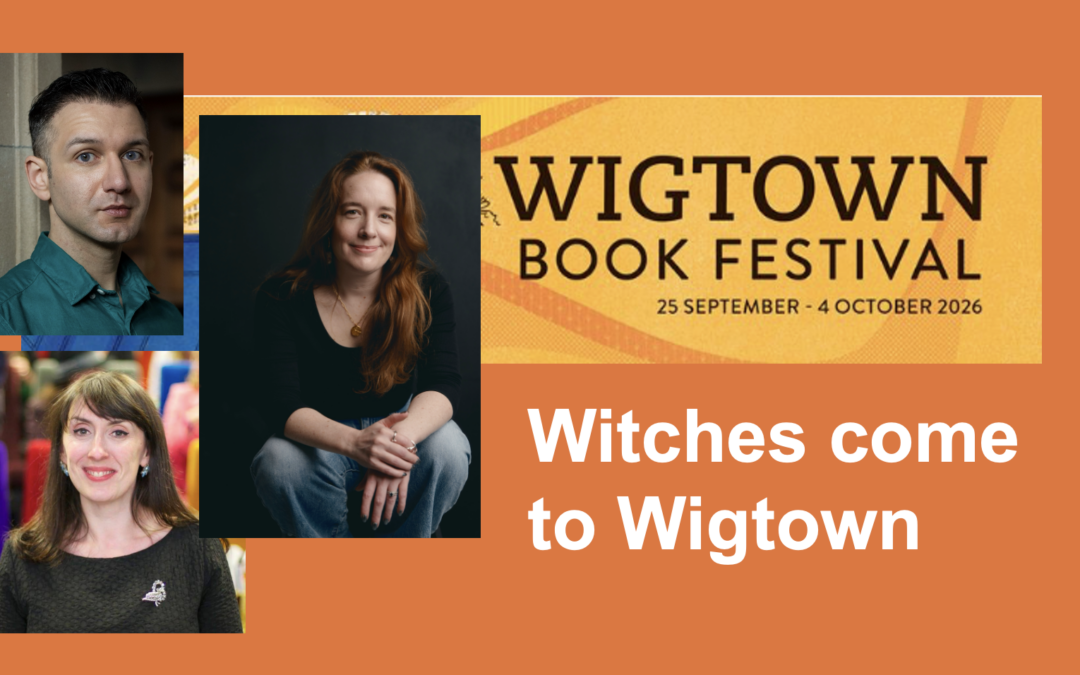
This weekend, as the full moon rises over Wigtown, folk from across Scotland will gather in Scotland’s National Book Town to hear about witches, elves, faeries and vampires.
It turns out that while witches have been merrily riding on broomsticks, and other implausible forms of air transport, for countless centuries but only donned their pointy hats in the 1700s.
Indeed, there have been many transfigurations in our ideas of who they are and what they do.
Among the speakers will be best-selling historical novelist Mairi Kidd (author of Newes of Witches), Strathclyde University historian Steven Veerapen (Witches) and bestselling folklorist Sarah Clegg (Perilous Enchantment: A True History of Fairies).
They are part of a special Witches and Other Lore strand in this year’s Wigtown Book Festival (25 September to 4 October).
Mairi’s book takes readers back the notorious period when Scotland endured repeated witchcraft panics that saw thousands of (mostly) women falsely accused, then sentenced to death and burning, some receiving the “mercy” of strangulation first.
Servants of Satan, they caused mayhem and disease and sought to destroy government and society – witches had to be destroyed. This was the king’s word and suggesting otherwise could be very risky.
Mairi said: “Scotland saw great turmoil in the 16th and 17th centuries, including political and religious disruption, climate challenge, food scarcity and outbreaks of plague and other disease.
“At the same time, society’s thinkers had something of a preoccupation with evil, as embodied by Satan, who could press ordinary people into his service as witches.
“So, when a community or individuals experienced hardship, it was perhaps natural to look for a ‘witch’ to blame.
“The reason it particularly affected women was that women were understood to be more vulnerable to the approaches of the Devil.
“No less a personage than King James VI said it was so; in his witch-finding manual Daemonologie, he said 20 witches were women to every one man.”
Much has changed and witches of the 20th and 21st centuries are as often benign as bad and can be comical rather than sinister.
Mairi believes there are many reasons why people find witches and witchcraft alluring – whether it’s horror at past injustice or a way to recast ideas about women and the world.
She said: “Some people read the witch – real or fictional – as an icon of female agency or power, or otherwise relevant to their lives today, for example teaching us about living in harmony with nature.
“Many believe in magic – perhaps that’s a natural human trait. It is, though, important to remember that Scotland’s accused and convicted ‘witches’ didn’t do any magic. As many memorials now say, ‘they were just folk’.”
Steven Veerapan points out that witches have a very long history and the Satanic associations burgeoned at a specific point in time.
And while there were those who sincerely believed that witches threatened society, many leapt on the bandwagon for power, money, revenge and advancement.
But even at the peak of the witchcraft persecutions, many accusations were treated with scepticism and the ideas that fuelled them were far from universally accepted.
He said: “The closer you are to Edinburgh and its educated elite, the more likely you are to find accusations and charges that are parroting these beliefs about Satan.
“And there were the people who sincerely believed they were the good guys, ridding the world of the evil of witches.
“But there were plenty of others. One laird laid multiple accusations against his own wife, but he wasn’t taken seriously because people thought he was after her money and property.”
Sadly, he believes we have failed to get over our tendency to stir up unfounded fears about members of our own society.
He said: “You can see today how easily people come to believe things. It’s often the same stuff, the same kind of tropes – ‘those people are bad, they hurt animals, they hurt children’.”
The idea of what a witch is and looks like has undergone immense changes.
Steven says: “Witches are perennially popular because you can keep reinventing them.
“In Classical times there was the proto witch – usually a woman who had magical powers and could fly. Christianity repackaged these ideas and overlaid its own beliefs.
“Then in the 16th century it solidified into this figure who makes a deal with the devil. You had written reports of witches flying on broomsticks – or other things like chairs or willow sticks.
“But it’s only in the 18th century you get the pointy hat. People have come up with all sorts of ideas to explain it, but there’s no real evidence for them.
“My own pet theory is that it was that people making woodcuts needed a clear, visual image for marking out witches – a pointy hat was easy to carve and did that. And it worked, ask any child today what a witch looks like and they can tell you.”
And the continued fascination?
Steven said: “Witches are amongst the first kind of figures that we meet when we’re children. They’re in fairy tales, in books, films and television shows. It’s ingrained in your imagination.
“So, they’re useful to storytellers because a witch can be scary, or they can be about wish fulfilment. Each generation makes them their own.”
But while some have sought to make the magical realm a cuter place with sitcoms ranging from Bewitched to Sabrinaand have turned faeries and elves into little cuties like Tinker Bell there are those who want to preserve the darkness.
Sarah’s book looks at how today’s Fae folk emerged from many sources including nymphs and pans of ancient Greece and Rome, the aes sidhe of Ireland and the elves of Germanic myth.
She says it was in around the 12th century that they first came together as a specific set of creatures, with set behaviours and appearances – and these are the ones she is drawn to.
Sarah said: “My personal preference is the dark, dangerous, alluring fairies of the middle ages, and I especially love the otherness of them – this feeling in so many of the stories that their interactions with humans are a sideline for them, that they have other things going on, things that we don’t understand and possibly couldn’t ever understand.”
“There’s real power and dread in them – this destabilising effect where you never know what will happen when a fairy appears, but you certainly know you need to be on your guard, no matter how beautiful and enchanting they might be.”
However, she thinks their durability is precisely because they are beings of human inventiveness.
She said: “Fairies have been with us for so long because there are so many versions of them – they’re darkness and danger, mischief and madness, cuteness and safety.
“We’re aware culturally of all of these different forms and we choose whichever work best for us, or whichever ones work best for a story.”
More Witches and Other Lore events
- Annaliese Avery. Annaliese discusses her young adults’ romantic fantasy series The Wycherleys.
- Dee Lawlor. Scotsferatu: The Vampire in Scottish Culture and Folklore: Explore the rich legacy of stories surrounding the idea of Scottish vampires through the centuries – including Galloway’s very own 16th-century bloodsucker.
- Aimee MacDonald and Rebecca Ferrier: Two debut novelists in conversation about magic, inspiration, terror, and Gothic fiction.
- Harriet Tyce. Witch Trial: The best-selling Scottish crime writer who became the breakout star of the BBC series Traitors discusses her new legal thriller set in Edinburgh’s High Court, with echoes of Scotland’s historical persecution of those accused of witchcraft.
-Ends-
Notes
- For more about Wigtown Book Festival see www.wigtownbookfestival.com
About VisitScotland
VisitScotland is Scotland’s national tourism and events organisation. Its core purpose is to drive the visitor economy, growing its value in Scotland. As an economic growth agency, VisitScotland’s activity focuses on three key priorities – market development, place development and business and experience development. VisitScotland’s work helps deliver the ambitions of the national tourism strategy, Scotland Outlook 2030, for Scotland to be a world leader in 21st century tourism, and Scotland’s National Events Strategy 2024 – 2035.
It leverages tourism and events as a force for good for all of Scotland’s people and places and builds Scotland’s international profile as a leading place to visit, live, work, study and do business. For VisitScotland’s press releases, tourism statistics and frequently asked questions go to visitscotland.org or follow us on @VisitScotland on LinkedIn.
About Creative Scotland
Creative Scotland is the public body that supports culture and creativity across all parts of Scotland, distributing funding provided by the Scottish Government and The National Lottery. Further information at creativescotland.com. Follow Creative Scotland on Facebook, LinkedIn, and Instagram.
For media information: Matthew Shelley at Matthew@ScottishfestivalsPR.org or 07786 704299.
Wigtown Festival Company, 26 South Main Street, Wigtown, Dumfries & Galloway, Scotland, UK, DG8 9EH. Wigtown Festival Company is a company limited by guarantee with charitable status. Scottish Charity No. SC037984
